
Testimony · Oct 7, 2026
DYRS's Proposed Community Placement Rules
Whitney Louchheim & Raymond Ngu · Open City Advocates
▶ Watch
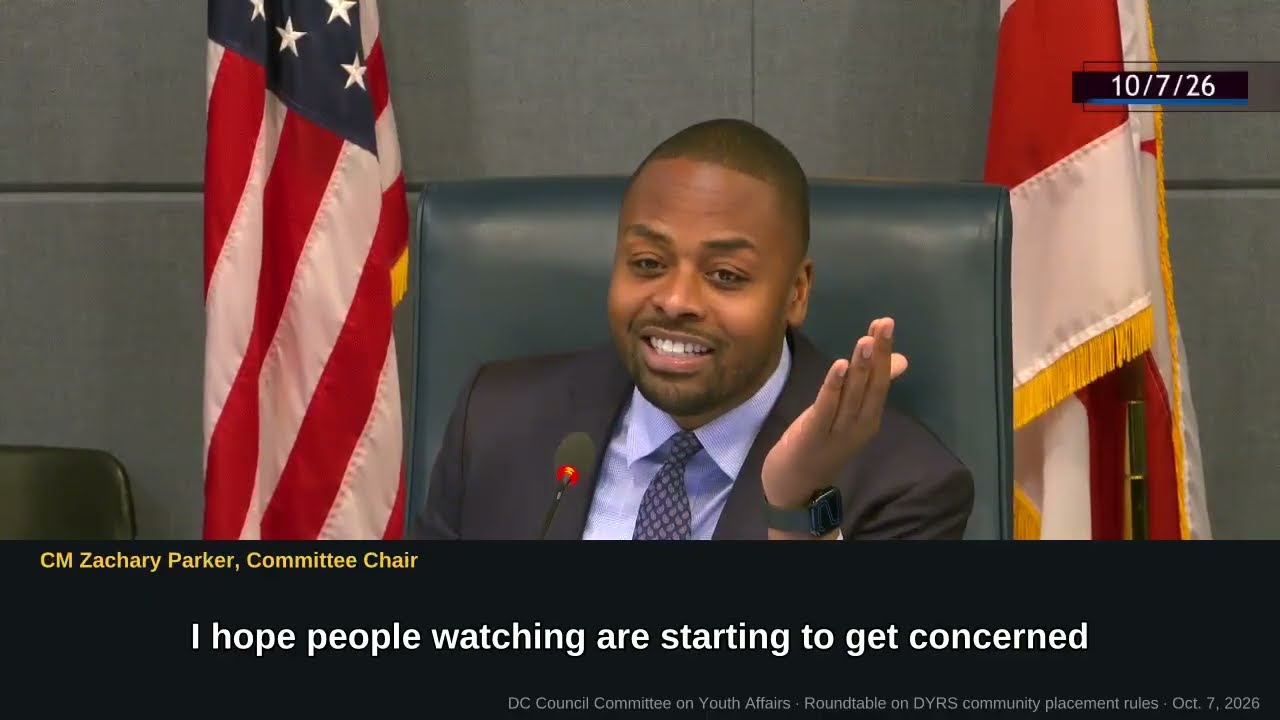
▶ Watch

Public Roundtable on DYRS’s Proposed Community Placement Rules (29 DCMR Chapter 12)
Committee on Youth Affairs, Council of the District of Columbia
Chairperson Zachary Parker
October 7, 2026
Testimony of Whitney Louchheim, Chief Operating Officer
Oral Testimony
Good afternoon, Chairperson Parker. My name is Whitney Louchheim, and I am the Co-Founder and Chief Operating Officer of Open City Advocates. We represent young people committed to DYRS, including in the hearings in which DYRS is trying to remove a child from the community and lock them up.
DYRS has proposed rewriting the rules for those hearings five times since 2015 and never finalized one. I have been involved in responding to every one of them, and in some cases, have had a chance to work on them beforehand. The current rules could use improvement, but this proposal makes them worse, and DYRS drafted it without input from us or other advocates.
In 2022, DYRS published a draft it wrote in collaboration with my organization and others, and said so in the D.C. Register: its changes came from discussions with the Public Defender Service, Georgetown Law’s Juvenile Justice Initiative, and Open City Advocates. That draft kept the three-member hearing panel. And on appeal, the Director could “only affirm or lower” the panel’s decision, and young people had ten business days to file an appeal. Our comment in response raised only two issues, which was a testament to the extensive collaboration that preceded publication.
Getting to the 2022 draft took years. We went through our redline with General Counsel Lindsey Appiah in a long and sometimes heated meeting in 2016, and after Judge Charles Thomas shared DYRS’s next draft with us in 2019, we worked on the text together in his Rules Committee throughout 2020. Starting in early 2023, even before Director Abed became Director in July of that year, we began asking DYRS’s Office of General Counsel seven times to see a draft or talk through what the agency was now considering. In the months before Director Abed started, General Counsel kept us abreast of their process and said the draft wasn’t ready. But by May 2024, the answer became a flat no.
The draft DYRS published in May of this year removes much of the progress we had made leading up to the 2022 version. The panel is gone, replaced by a single hearing officer the Director picks. How restrictive a child’s placement should be is now decided by a DYRS executive who doesn’t even sit through the hearing. A young person who wants to appeal has only three business days to do it, and, importantly, the Director can use that appeal to make the outcome even more restrictive.
This is not just hypothetical. Director Abed has, in fact, raised our client’s level of restriction on appeal. The 2022 draft would have prohibited that. Furthermore, three business days—the time the new draft gives a young person to file an appeal—is not enough time to share the written decision with the client, discuss the pros and cons of appealing (which are now quite serious), and write an appeal worth filing. Seven days was tight, and the 2022 draft allowed ten. There is also now no hearing where counsel can even argue about the most appropriate level of restrictiveness or the best placement because the Deputy Director would now decide it on paper. If an appeal can result in an even worse decision, a young person may not challenge even a plainly unfair decision. When an appeal can make things worse, the first thing a lawyer has to tell a child is that it might.
All we are asking for here is a fair process. Besides being a bedrock of our constitution, fair process also serves public safety. Young people who perceive the process as fair are more likely to participate in programs and follow the law; a child who feels they were treated fairly is much more likely to buy into a program that holds them accountable.
We ask the Committee for two things. First, press DYRS to commit in writing that it will not finalize this rule before the new mayoral administration takes office in January, and that it will use the time to answer the public comments and explain each reversal from 2022. Second, press DYRS to meet with the Public Defender Service, Open City Advocates, and young people and families, and go through our redline together, the way we did with Judge Thomas.
Thank you. I welcome your questions.
Written Testimony
Good afternoon, Chairperson Parker and members of the Committee. My name is Whitney Louchheim, and I am the Chief Operating Officer of Open City Advocates. We represent young people committed to the Department of Youth Rehabilitation Services after sentencing, including in Community Status Review Hearings, in which DYRS tries to remove a child from the community to a more secure facility.
DYRS has proposed rewriting the rules for those hearings five times since 2015, and it has never finalized one. Through Open City Advocates, I have been involved in responding to every one of those proposals, from the first public comment in 2015 to the drafting table in 2020. Our Legal Director, Raymond Ngu, and our colleagues at the Public Defender Service will address the legal defects in the current draft. I want to show the Committee what these rules looked like when DYRS wrote them with us and what they look like now that it writes them alone, and then say what DYRS should have to do before it makes this proposal final.
The current rules, adopted in 2009,¹ could certainly be improved, and we have worked with DYRS to help craft those improvements. This year’s proposal makes them worse, and DYRS wrote it entirely without our input.
Chapter 12 of the DCMR governs when DYRS can take a young person out of a group home, a foster home, or their own family’s home and place them in a more secure setting, including incarceration. In every one of these hearings, DYRS is the party asking to restrict the child’s liberty. DYRS also writes the rules, picks the hearing officer, decides the level of restrictiveness, and hears the appeal. When one party does all of that, the people on the other side need a seat at the drafting table.
In November 2022, DYRS published a proposal it had developed in collaboration with my organization and others. The agency even stated in the D.C. Register that it had made its changes “[a]s a result of submitted comments and discussions with the District of Columbia’s Public Defender’s Office, Georgetown Law School’s Juvenile Justice Initiative, Open City Advocates (formerly Mentoring Today), and other juvenile justice advocates.“² The first change it listed was reinstating the three-member hearing panel (which is in the current regulations but had been removed in draft proposals prior to 2022). On appeal, the Director could “only affirm or lower” the panel’s decision,³ and the young person had ten business days to file an appeal.⁴ Supervisors could send a case to a Team Decision Making Meeting instead of a hearing,⁵ and when the panel set a level of restrictiveness, it could weigh whether DYRS itself had delivered the services the child needed.⁶ Our December 2022 comment thanked DYRS for its “willingness to adopt many of the recommendations” we had made and raised concerns in only two areas.⁷ For reasons I do not know, that version of the DCMR never became final.
The proposal DYRS published on May 22, 2026, reverses that work.⁸
| 2022 proposal | 2026 proposal | |
|---|---|---|
| Who hears the case | Three-member panel, restored at advocates’ request | Single hearing officer, a DYRS employee chosen by the Director |
| Who decides how restrictive the placement will be | The panel, after the hearing | The Deputy Director of Youth and Family Programs, a DYRS executive, without a hearing |
| What the Director can do on appeal | Affirm or lower the level only | Substitute his own level, including a harsher one |
| Who can appeal | The young person | Either party, including DYRS |
| Time to file an appeal | Ten business days | Three business days (the current rule allows seven) |
The sources for each row are in the notes.⁹ Three months before publishing this proposal, DYRS told this Committee in writing that its revisions were “designed to simplify the revocation process while protecting the youth’s due process rights,” and that “[t]here are currently no regulatory impediments to DYRS’ operations.“¹⁰ At the same hearing, Director Abed testified that DYRS had been “strengthen[ing] partnerships and amplify[ing] youth voices.“¹¹ DYRS did not consult us on this proposal, and it did not consult the young people and families we represent.
The draft DYRS published in May of this year removes much of the progress we had made leading up to the 2022 version. The panel is gone, replaced by a single hearing officer the Director picks. A young person who wants to appeal has only three business days to do it, and, importantly, the Director can use that appeal to make the outcome even more restrictive.
This is not just hypothetical. Director Abed has, in fact, raised our client’s level of restriction on appeal. The 2022 draft would have prohibited that. Furthermore, three business days—the time the new draft gives a young person to file an appeal—is not enough time to share the written decision with the client, discuss the pros and cons of appealing (which are now quite serious), and write an appeal worth filing. Seven days was tight, and the 2022 draft allowed ten.
There is also now no hearing where counsel can even argue about the most appropriate level of restrictiveness or best placement because the Deputy Director decides it on paper. When the appeal itself can send a child somewhere worse, the first thing counsel has to tell the child is that it might, and many will decide the risk is too great, even if the initial decision was patently unfair or erroneous.
It took seven years to get to the 2022 draft.
In June 2015, DYRS published its first proposed rewrite without telling us it was coming. We joined the Public Defender Service in a public comment, objecting that DYRS had acted “without any notice” to advocates.¹² Afterward, Director Clinton Lacey assured our coalition that DYRS would share any new proposal with us before publishing it. In May 2016, DYRS published a second proposal without doing so.¹³ On June 3, 2016, we filed a second joint comment and met with DYRS’s General Counsel, Lindsey Appiah, who now serves as Deputy Mayor for Public Safety and Justice. She agreed not to finalize the rules until we could suggest alternatives.¹⁴ That August, other advocates and I met with her to go through our redline comments. It was a long meeting, and at times a heated one. By the end, we understood what she wanted, and she understood, or seemed to understand, what we wanted. The 2016 proposal was never finalized, and we heard nothing more for three years.
In October 2019, DYRS Administrative Law Judge Charles Thomas shared the agency’s latest draft with us before it was published and asked for our input.¹⁵ It was the first time DYRS had shown us a draft before publishing it. Our November 2019 letter noted that his draft “takes into account many of the concerns raised by our group” in 2015 and 2016.¹⁶ In early 2020, Judge Thomas created a Rules Committee and invited advocates to join, and through the first months of the pandemic we worked with him on the text itself. While we did not always agree with Judge Thomas, he was earnestly and sincerely trying to make this a fair process and to give young people the due process they need and deserve. And he was committed to giving youth advocates a full voice in the drafting process. The 2022 proposal was the product of that work.
Since April 2023, we have put these regulations on the agenda at seven of our regular meetings with DYRS’s Office of General Counsel, asking to see a draft, to comment on the changes DYRS was considering, or just to discuss them.¹⁷ The first three meetings came before Director Abed arrived in July 2023. General Counsel Aisha Braithwaite Flucker had held her position since May 2022, so the 2022 proposal was published on her watch, and before Director Abed arrived she was open with us about the agency’s process. In June 2023 she told us DYRS was holding weekly review meetings on the revisions, including with the Office of the Attorney General. She never promised us a draft, but she had not said no. In May 2024, when we asked again, she told us point-blank that we would not see DYRS’s revisions until the public comment period. We kept asking for two more years, and each time the answer was no. In the end, the Office of General Counsel told us the public comment period was our opportunity to weigh in. Our coalition filed a joint comment and a full redline on July 1.¹⁸
Our reasons for asking to see drafts are practical. DYRS is going to hear every problem we see in a public comment anyway; if we see the draft first, many of those problems get fixed in a meeting, and our comment gets much shorter. Defense counsel are also in these hearings year after year, and we see where the process goes wrong and where it could work better. It makes little sense to ask only one party to the hearing how the rules should be improved. The record bears this out: the rules improved, and our disagreements narrowed, in the years DYRS collaborated with us.
As an illustration, take the power to raise a child’s level of restrictiveness on appeal. DYRS first proposed giving the Director that power in 2015, and we objected that year and again in 2016.¹⁹ Judge Thomas agreed with us that the Director should not have it. If an appeal can make things worse, a young person may decide not to challenge even a plainly unfair decision, because the risk is too great. Judge Thomas felt so strongly about this that, while the draft rules were pending, he told young people at the start of their hearings, when he explained their right to appeal, that the Director could not raise their level. The rules themselves had not yet changed. Giving this additional power to the Director is not just hypothetical. Director Abed has, in fact, raised our client’s level on appeal. That is the outcome the 2022 draft would have prohibited, and the 2026 draft permits.
Our joint comment and redline describe the legal defects in the current proposal in detail. In addition, these are changes I have raised with DYRS for years:
- Before DYRS holds a child pending a hearing, a neutral decision-maker should answer two separate questions: whether there is evidence that a violation occurred, and whether there is a reason to detain the child until the hearing. In practice, decision-makers have often answered only the first. DYRS staff speak of a “five-day hold,” but the regulations authorize detention before a hearing only on the way to a hearing, with a probable cause finding and a hearing within five days.²⁰ When DYRS places a child at the Youth Services Center for several days and never files for a hearing, none of that happens: no one finds probable cause, and no hearing is ever set. By the time counsel could get a court to look at it, the child is already out, and nothing stops it from happening again.
- On appeal, the Director may affirm or lower a decision, and nothing more.
- For technical violations of a Community Placement Agreement and new minor charges, such as misdemeanors, DYRS should be required to convene a Team Decision Making Meeting and to offer restorative justice and graduated responses before it seeks revocation. DYRS’s own 2017 Care Planning and Coordination Handbook tells Care Coordinators to “use the CSRH as a last resort after a series of graduated sanctions have been used,” and says that “non-compliance and even defiance are not reasons to incarcerate youth, even if that youth has committed minor crimes.“²¹ The proposal should mirror that philosophy.
- In deciding whether to revoke a young person’s placement, not only in setting the level afterward, the decision-maker should consider whether DYRS delivered the services it promised. Today we can raise that only in mitigation.
- Many of these cases are resolved by waiver, which functions much like a plea. Waivers should require an attorney’s advice and signature as well as a time limit on how long the young person stays at the higher level.
Fair process also serves public safety. Jeffrey Fagan and Tom Tyler found that adolescents who see the law as legitimate and its procedures as fair are less likely to break the law.²² In these hearings I have seen how much it matters to a young person to be heard. A young person who got a fair shot and had the chance to tell their story can buy into a program that holds them accountable; one who believes the outcome was decided before they walked in has no reason to. Fairness is also owed to a child whose liberty is at stake, whether or not it pays off in public safety.
We ask the Committee to use its oversight role to press DYRS on four points:
- DYRS should commit, in writing, that it will not publish a final rule before the next administration takes office in January 2027, and that it will use the intervening time for the work described below. A rule that has taken eleven years should not be finalized in the last weeks of an administration, before the agency has answered the public comments.
- DYRS should convene working sessions with youth advocates, including the Public Defender Service and Open City Advocates, to discuss and collaborate on potential changes, as Judge Thomas did in 2019 and 2020. This time, DYRS should also involve young people and their families in the process.
- For each major change from the 2022 draft, including eliminating the panel, giving the Deputy Director the restrictiveness decision, allowing the Director to impose a harsher outcome on appeal, and shortening the appeal window, DYRS should give the Committee its written rationale and any data it relied on, and should identify the operational problem each change solves.
- DYRS should share with the Committee its written response to the July 1 joint comment before taking any further action on the rule.
We have already submitted the redline. The last time DYRS worked through one with us, it produced a proposal the agency itself credited to that collaboration. We are asking it to do that again before these rules become final. Thank you for the opportunity to testify. I welcome your questions.
Appendix A. Timeline of the Chapter 12 rulemakings
| Date | Event | Source |
|---|---|---|
| June 26, 2009 | Current Chapter 12 rules take effect | 56 D.C. Reg. 5035 |
| June 12, 2015 | First Notice of Proposed Rulemaking, published without advance notice to advocates | 62 D.C. Reg. 8326 |
| July 10, 2015 | Joint comment with PDS | Coalition letter (on file) |
| Later in 2015 | Director Lacey assures coalition DYRS will share future proposals before publication | OCA records |
| May 6, 2016 | Second Notice of Proposed Rulemaking, again without advance notice | 63 D.C. Reg. 6952 |
| June 3, 2016 | Second joint comment with PDS; meeting with General Counsel Appiah, who agrees not to finalize | Coalition letter (on file), at 1 |
| Aug. 19, 2016 | In-person meeting with then-General Counsel Lindsey Appiah on redline comments | OCA records |
| Oct. 2, 2019 | Judge Thomas offers input on DYRS’s draft and shares it before publication | Coalition letter of Nov. 13, 2019, at 1 |
| Nov. 13, 2019 | Joint letter memorializing recommendations | Coalition letter (on file) |
| Jan.–Aug. 2020 | Collaborative drafting; Judge Thomas forms DYRS Rules Committee (Feb. 2020); PDS, DYRS, and OCA meet with Family Court Judges Hertzfeld and Di Toro on Article VI issues (Aug. 13, 2020) | OCA records |
| Oct. 15, 2021 | Third Notice of Proposed Rulemaking | 68 D.C. Reg. 10769 |
| Nov. 2021 | Joint comment with PDS | Coalition letter (on file) |
| Jan.–Mar. 2022 | Continued collaboration on draft text | OCA records |
| May 2022 | Aisha Braithwaite-Flucker becomes DYRS General Counsel | LinkedIn profile |
| Nov. 18, 2022 | Fourth Notice of Proposed Rulemaking, crediting PDS, Georgetown, and OCA; later withdrawn | 69 D.C. Reg. 14279 |
| Dec. 19, 2022 | Joint comment narrowed to two areas | Coalition letter (on file) |
| Apr. 6, May 4, June 22, 2023 | Advocates ask OGC to see or discuss the DCMR draft; OGC describes its process and says the draft isn’t ready | OCA meeting notes |
| July 2023 | Director Abed takes office | |
| May 2, 2024 | OGC states advocates will not see revisions before the public comment period | OCA meeting notes |
| July 8, 2024; Feb. 10 and Apr. 9, 2026 | OGC declines further requests to see or collaborate on the DCMR draft | OCA meeting notes |
| Feb. 9, 2026 | DYRS tells Committee revisions will “simplify the revocation process while protecting the youth’s due process rights”; “no regulatory impediments” | FY25 Performance Oversight Responses, at 38 |
| May 22, 2026 | Fifth Notice of Proposed Rulemaking | 73 D.C. Reg. 7932 |
| July 1, 2026 | Coalition joint comment and redline | Joint Letter (on file) |
Appendix B. Questions the Committee may wish to ask DYRS
- Will DYRS commit in writing, by October 31, 2026, not to publish a final Chapter 12 rule before January 2, 2027, and to convene working sessions with the July 1 commenters before then?
- By what date will DYRS deliver to the Committee its written response to the July 1, 2026, joint comment and redline?
- In February, DYRS told this Committee there were “no regulatory impediments” to its operations. What operational problem does each of the following changes solve: eliminating the panel, moving the restrictiveness decision to the Deputy Director, cutting the appeal window to three days, and allowing the Director to raise the level of restrictiveness on appeal? Please provide the rationale and any data by November 15.
- The 2022 proposal said the Director “may only affirm or lower” a decision on appeal and gave youth ten business days to appeal. What changed between 2022 and 2026 to justify reversing both?
- The 2022 proposal reinstated the three-member panel after advocates objected to a single hearing officer. What evidence led DYRS to eliminate the panel again?
- How many youth were held in secure custody pending a Community Status Review Hearing in FY2025 and FY2026, how many of those holds exceeded five days, and in how many was no petition ever filed?
Notes
- 29 DCMR §§ 1200–1299, 56 D.C. Reg. 5035 (June 26, 2009).
- Dep’t of Youth Rehab. Servs., Fourth Notice of Proposed Rulemaking, 69 D.C. Reg. 14279 (Nov. 18, 2022) (preamble).
- Id. (proposed 29 DCMR § 1211.7); see also id. (proposed § 1212.6) (same limit after remand).
- Id. (proposed § 1211.6).
- Id. (proposed §§ 1203.7(b), 1205.3, 1206.3).
- Id. (proposed § 1211.4).
- Letter from Pub. Def. Serv. and Open City Advocates to Hilary Cairns, Director, Aisha Braithwaite-Flucker, General Counsel, and Charles Thomas, Administrative Law Judge, DYRS, at 1 (Dec. 19, 2022) (on file with Open City Advocates).
- Dep’t of Youth Rehab. Servs., Notice of Fifth Proposed Rulemaking, 73 D.C. Reg. 7932 (May 22, 2026); see also Errata Notice, 73 D.C. Reg. 8253 (June 5, 2026) (extending comment period to July 1, 2026).
- Panel: 73 D.C. Reg. 7932 (preamble, item 1; proposed §§ 1208.6–1208.8); 69 D.C. Reg. 14279 (preamble, item 1). Restrictiveness: 73 D.C. Reg. 7932 (preamble, items 5–6; proposed § 1209); 69 D.C. Reg. 14279 (proposed § 1211.4). Director on appeal: 73 D.C. Reg. 7932 (preamble, item 7; proposed § 1210.6); 69 D.C. Reg. 14279 (proposed § 1211.7). Who can appeal: 73 D.C. Reg. 7932 (preamble, item 10; proposed § 1210.1); 69 D.C. Reg. 14279 (proposed § 1211.6). Deadline: 73 D.C. Reg. 7932 (proposed § 1210.1); 69 D.C. Reg. 14279 (proposed § 1211.6); 29 DCMR § 1211.7 (2009) (seven business days).
- D.C. Dep’t of Youth Rehab. Servs., FY25 Performance Oversight Question Responses, prepared for the Committee on Youth Affairs, at 38 (response to Question 59) (Feb. 2026).
- Joint Letter, infra note 18, at n.6 (quoting testimony of Director Sam Abed, Fiscal Year 2025 Performance Oversight Hearing, Committee on Youth Affairs (Feb. 9, 2026)).
- Dep’t of Youth Rehab. Servs., Notice of Proposed Rulemaking, 62 D.C. Reg. 8326 (June 12, 2015); Letter from Pub. Def. Serv. et al. to Adam Al-Joburi, Legislative Affairs Specialist, DYRS, at 1 (July 10, 2015) (on file with Open City Advocates).
- Dep’t of Youth Rehab. Servs., Notice of Second Proposed Rulemaking, 63 D.C. Reg. 6952 (May 6, 2016).
- Letter from Pub. Def. Serv. et al. to Lindsey Appiah, General Counsel, DYRS, at 1 (June 3, 2016) (“We also appreciate your willingness not to make the proposed changes final until we have been able discuss with you in more detail the concerns outlined in these comments and to make suggestions for alternative approaches[.]”) (on file with Open City Advocates).
- Letter from Pub. Def. Serv., Open City Advocates, and Georgetown Juvenile Justice Initiative to Charles Thomas, Administrative Law Judge, DYRS, at 1 (Nov. 13, 2019) (on file with Open City Advocates).
- Id. (“We note that this October 2019 proposal takes into account many of the concerns raised by our group in our July 10, 2015, and June 3, 2016, letters to the agency after the agency’s last two notices of proposed changes.”).
- Open City Advocates, notes of meetings with DYRS Office of General Counsel (Apr. 6, 2023; May 4, 2023; June 22, 2023; May 2, 2024; July 8, 2024; Feb. 10, 2026; Apr. 9, 2026) (on file with Open City Advocates).
- Joint Letter from Pub. Def. Serv., Open City Advocates, et al. to Aisha Braithwaite-Flucker, General Counsel, DYRS, re: Proposed Changes to Chapter 12 of Title 29 of the DCMR (July 1, 2026) (on file with Open City Advocates).
- Letter of July 10, 2015, supra note 12, at 2–4; Letter of June 3, 2016, supra note 14, at 9.
- 29 DCMR §§ 1204.1(e), 1208.6–1208.10 (2009) (probable cause determination within one business day of detention; hearing within five calendar days).
- D.C. Dep’t of Youth Rehab. Servs., Care Planning and Coordination Handbook H-32 ¶ 5, B-5 (Apr. 2017).
- Jeffrey Fagan & Tom R. Tyler, Legal Socialization of Children and Adolescents, 18 Soc. Just. Res. 217, 233–35 (2005).
Testimony of Raymond Ngu, Legal Director
Good afternoon, Chairperson Parker and members of the Committee. My name is Raymond Ngu and I am the Legal Director of Open City Advocates; we are a legal services organization that represents youth committed to DYRS.
The proposed regulations completely upend the Community Status Review Hearing (CSRH) process and transform it from an imperfect, but tolerable system to one that virtually guarantees that the agency will be able to re-incarcerate any committed youth at any time by disregarding important procedural due process protections. From start to finish, the proposed rules are designed to allow DYRS multiple bites at the apple. But due process is not just some lofty ideal that the agency should strive to abide by if it can; these hearings concern a youth’s liberty and we should all take seriously the obligation to safeguard that fundamental right.
I’ll start with the expanded criteria for initiating a CSRH. Under current rules, DYRS can only initiate a hearing if a youth is charged with certain offenses or if they have violated the terms of their Community Placement Agreement (CPA) which sets out their supervision conditions. Under the proposed rule, the agency is permitted to initiate hearings, not only for alleged CPA violations, but also if a youth is “unsuccessfully discharged from placement” or “the behavior of the youth poses a risk to public safety.“¹ These terms are either undefined or so broad as to be entirely within the agency’s discretion. Because of that, they essentially allow DYRS to initiate a hearing whenever they want, even if a youth has not violated any conditions of supervision they have agreed to abide by.
Then, the DYRS Deputy Director decides whether the youth will be securely detained pending the hearing, a decision currently made by an impartial administrative law judge or hearing officer.
Next, the proposal puts the ultimate decision making authority about placement squarely in the agency’s hands. Under current rules, a group made up of a hearing officer and two panel members decide both whether a CPA violation has occurred and whether a youth’s level of restrictiveness should be raised. DYRS proposes to eliminate this structure and consolidate authority within the agency; the Deputy Director, who was not present at the hearing, would be the sole decisionmaker about a youth’s level of restrictiveness after a hearing. Youth and their attorneys will no longer have a full evidentiary hearing about what their level should be; instead, they will be limited to a written statement that the new rules allow the Deputy Director to completely disregard when making the placement decision.
Finally, after all this, the proposal newly gives DYRS the ability to appeal an unfavorable decision to the DYRS Director or even D.C. Superior Court. This is the final way in which DYRS is trying to ensure that it can incarcerate a child regardless of due process violations.
To summarize, if the new rules go into effect, this is how attorneys will have to explain the process to clients: if DYRS no longer wants you in the community, they can initiate a CSRH even if you haven’t violated any condition of your supervision and the Deputy Director will decide whether you should be detained at YSC until your hearing; then a DYRS-appointed Hearing Officer will determine if you pose a risk to public safety for which there is very little criteria or guidance; if so, the Deputy Director, the same person who approved initiating the CSRH and your detention at YSC, will decide what your new placement will be; and, if DYRS isn’t happy with any part of that process, they can appeal it to the DYRS Director who can also raise your level of restrictiveness on appeal. In short, this process essentially gives the Director the ability to determine the outcome in all cases.
We know from adolescent development research that youth are far more likely to buy into and abide by a process that they feel is fair. In tipping the scales so significantly, the agency has not only undermined actual due process, but has created a system under which no youth will feel like they have a fair chance to succeed and thus will be less likely to want to engage in DYRS’ rehabilitative services.
We have submitted for the record the detailed public comment that was jointly signed by twenty DC-based organizations and individuals who work on behalf of court-involved youth and related populations, all of whom oppose the new regulations as proposed. We strongly urge DYRS to withdraw the rule changes, or delay finalization, in order to consult with youth, families, and advocates to ensure a process that is fair and conforms to the due process protections that all youth deserve.
¹ “A determination based on available information that a youth poses a risk of significant harm to themselves or others, or to property.”
Free to quote and share with attribution.